Miss Stubbs
All Creatures Great and SmallMiss Stubbs is a chronically ill woman who has spent years confined to a small cottage room, with her dogs and cats as her closest companions. Her story brings together the everyday work of veterinary care and a private fear she has never voiced before: that death may separate her from the animals who have made her life bearable. In the face of that fear, James Herriot offers not doctrine but a personal conviction about love, loyalty, and reunion.
A Life Centered on Home and Animals
Miss Stubbs’s room is on the ground floor at the front of the cottage. Above her bed hangs a strip of cardboard, about eight inches long, lettered simply “God is Near” and looped over an old gas bracket. Its plain capitals resemble a practical notice more than an ornate religious image. From her bed, Miss Stubbs can see little beyond a few feet of privet hedge through frayed curtains and the clutter of the room that has been her world for years. She will never get up again, but she does not dwell on her own illness or pain when speaking to Herriot. Her concern is for her three dogs and two cats.
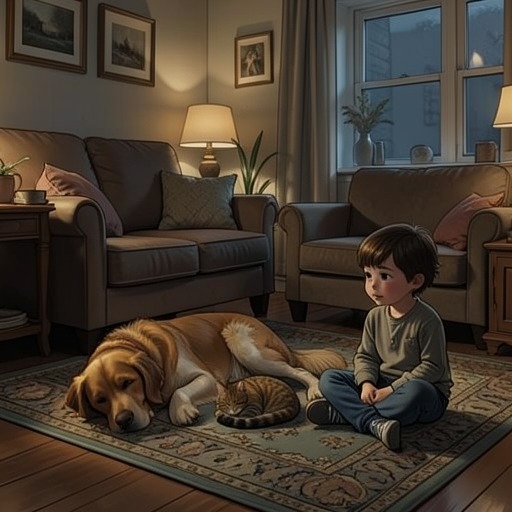
Herriot has visited regularly for more than a year, and the visit follows a familiar pattern: the dogs bark furiously, Mrs. Broadwith moves the animals into the back kitchen, and Herriot attends to his patient. Afterward, tea and the return of the other animals make the room a shared domestic space. Ben, a Sealyham, and Sally, a Cocker Spaniel, join Prince in a noisy welcome; the cats, Arthur and Susie, follow and rub against Herriot’s trouser legs. The tea ritual recurs beneath the small card above the bed. When Herriot asks how she is, Miss Stubbs says she is better and promptly changes the subject.
Care, Age, and the Burden of Responsibility
The animals’ devotion is a source of light in Miss Stubbs’s life, but their age makes that comfort precarious. A fourth dog, an ancient golden Labrador, has already died. The remaining animals are all at least ten years old, and each has a different problem: Prince has serious heart disease; Sally’s increased drinking raises Herriot’s concern about possible pyometra; and Ben is growing thinner with nephritis. Herriot doubts that the hexamine tablets prescribed for Ben will help much, and his rapidly growing claws require repeated clipping. These particulars make care an ongoing responsibility rather than a single act of treatment: Herriot watches for decline while Miss Stubbs depends on a household of vulnerable companions.
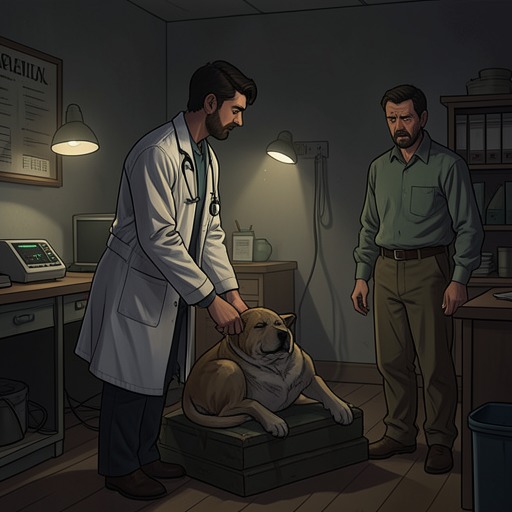
Ben’s collapse abruptly turns that concern into bereavement. Summoned urgently by Mrs. Broadwith one evening, Herriot reaches the cottage in under ten minutes. The familiar barking begins as he knocks, but Ben is silent; inside, the old dog lies very still beside the bed. His death is especially sudden for a nephritis case, though albumen in his urine had been rising to a dangerous level. The clinical shorthand of the day book, “D.O.A.”, registers the fact of death, while Herriot’s thought that he will no longer clip Ben’s claws gives that loss its intimate, habitual measure.
Miss Stubbs does not cry as Herriot prepares to carry Ben away. She asks him to wait, turns with effort, and lightly touches the head of the companion who has been beside her for so long. After Mrs. Broadwith leaves to arrange burial, Herriot stays with her. Miss Stubbs says that Ben’s death means her own turn will come next. She insists she is not afraid of dying and believes something better awaits her, but the calm confidence is not the whole of her response.
The Fear Behind Her Faith
For the first time, Miss Stubbs confesses a fear: she may never see her dogs and cats again. She believes she will be reunited with her parents and brothers, but has read that animals have no souls and knows that many religious people share that view. Her distress is not an abstract theological debate. It concerns whether the relationships that have sustained her in life can survive death.
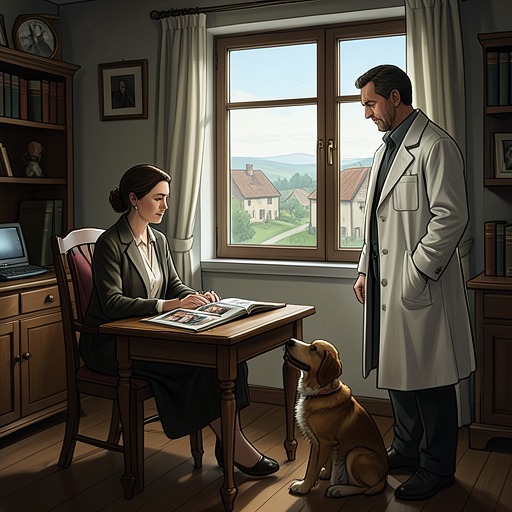
Herriot answers that he does not believe animals lack souls. He connects the idea of a soul to the animals’ capacity for love, loyalty, and gratitude, and tells her she need not worry. Her tension eases and her familiar spirit returns, but she asks him not to offer mere reassurance: she wants him to be absolutely honest about what he believes. Herriot admits that he is foggy about the larger questions, while remaining certain that wherever Miss Stubbs is going, the animals are going too. She asks whether this is genuinely his belief, and he confirms that it is. The scene leaves the afterlife unresolved as doctrine, but makes the exchange consequential as an act of trust: Herriot’s assurance matters because he presents it as his own honest conviction, not as certain religious authority.
Continuity Beyond the Cottage
The story later finds Mrs. Broadwith in a new place that she says is just what she has always wanted. Herriot’s first concern is what has happened to the animals. Mrs. Broadwith tells him they are in the garden, where there is plenty of space, and he watches them come inside. Arthur springs onto Herriot’s knee and arches against his arm, purring; Prince, still wheezy, wags his tail and barks delightedly. Their arrival confirms that the animals have not been lost from the circle of care that Miss Stubbs depended on. The narrative does not settle the theological question she raised, but it gives her attachment a concrete continuation through Mrs. Broadwith’s care and the animals’ reunion with Herriot.
Narrative and Thematic Significance
Miss Stubbs is defined not simply by confinement or illness but by the relationships she sustains within that restricted life. The plain “God is Near” card frames her bedside, yet the decisive religious question emerges only after Ben dies: whether love between human beings and animals can endure beyond death. Her composure at the bedside, her sudden terror when she names her fear, and her insistence on Herriot’s honesty give the scene its emotional movement. The pets are not incidental comforts; their aging, illnesses, and deaths shape her daily life and make the prospect of separation specific. Through Miss Stubbs, veterinary care becomes a form of companionship extending beyond diagnosis, while the answer to her spiritual fear remains personal, tender, and deliberately short of proof.